Brightbit
Full-lifecycle software engineering

Every type of software development service, in one place

Twelve practices, one delivery standard. Whether you need a single mobile app, an ERP rollout across twelve branches, an AI model with a human review queue, or someone to take over a system nobody understands any more — this page tells you exactly what you get, who works on it and how long it takes.

What the work looks like

Six of our practices, drawn as the screens and pipelines they actually produce. Use the arrows, drag, or the arrow keys.

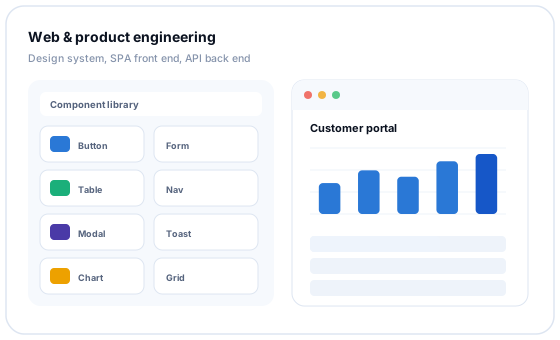
Web and product engineering: a reusable component library feeding a customer portal screen with a bar chart.
Web & product engineering
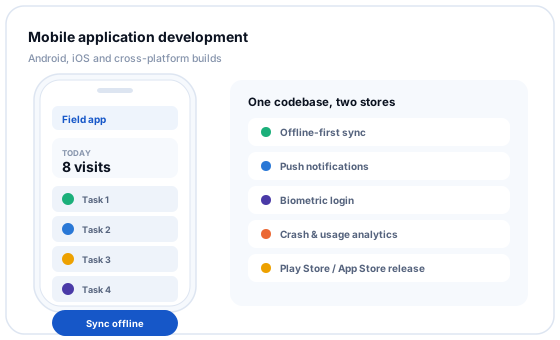
Mobile development: an offline-first field app screen beside a list of platform capabilities.
Mobile applications
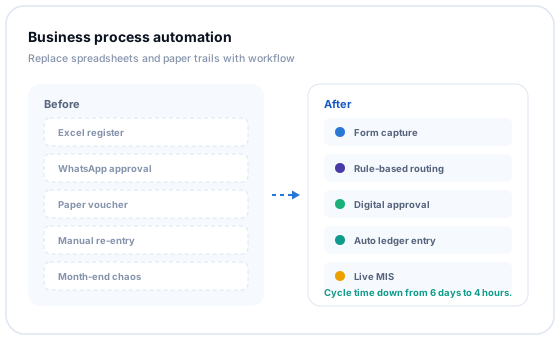
Business process automation: a spreadsheet and paper workflow replaced by a routed digital workflow.
Business process automation
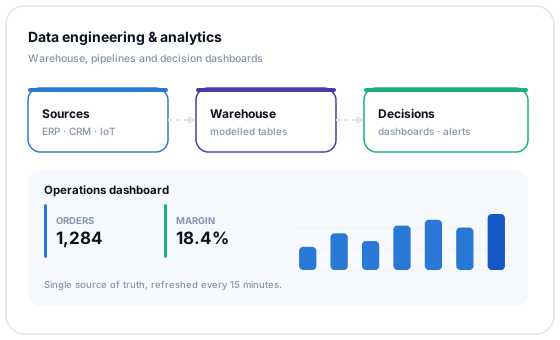
Data engineering: sources feeding a warehouse and then decision dashboards.
Data engineering & analytics
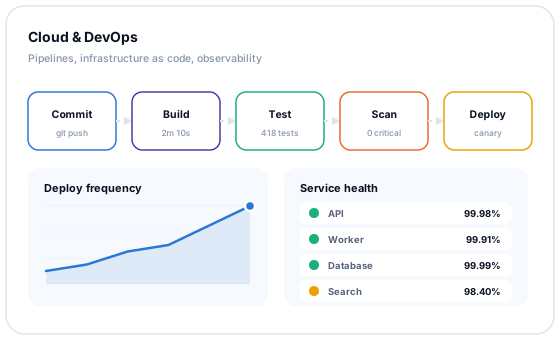
Cloud and DevOps: a five-stage CI/CD pipeline with deploy frequency and per-service uptime.
Cloud & DevOps
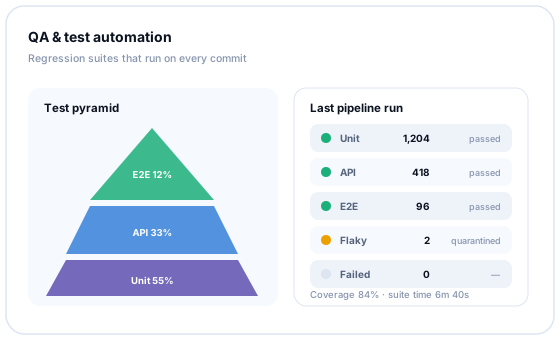
QA and test automation: a test pyramid beside the latest pipeline results.
QA & test automation
Before you read twelve service descriptions

How a build actually gets spent

Two charts we show in every kick-off, because the biggest cause of a disappointed client is a surprise about where the time goes.

Effort split by project type

Share of total engineering hours

A typical 12-week delivery plan

Hover any bar for the exact window

The twelve practices

Services in detail

1. Custom software & web product engineering

The core of what we do: browser-based applications that replace a pile of spreadsheets and half-remembered rules. Customer portals, dealer and distributor networks, admin consoles, internal tools and multi-tenant SaaS products.

  • Angular or React front end on a design system, so screen twenty looks like screen one.
  • .NET, Java or Node.js API with role-based access control and an audit trail on every write.
  • SQL Server or PostgreSQL schema designed for the reports you will want later, not just the forms you need now.
  • Excel import and export everywhere, because your team will keep using Excel and that is fine.
Typical size
8–20 weeks, squad of 4–6
You receive
Source code, schema documentation, API reference, deployment runbook
Stack
Angular · React · TypeScript · .NET · Java · Node.js · SQL Server · PostgreSQL

2. Mobile application development

Apps for people who are standing up: field engineers, delivery staff, teachers taking attendance, parents checking a fee receipt on a two-bar connection.

  • Offline first. Capture works with no network; sync resolves conflicts when it returns.
  • Push notifications, biometric login, camera capture, GPS trails and QR scanning.
  • Play Store and App Store release management, including staged rollouts.
  • Crash and usage analytics from day one, so the second release is informed by evidence.
Typical size
6–14 weeks, squad of 3–5
Approach
Cross-platform by default; native when the hardware demands it
Stack
Flutter · React Native · Kotlin · Swift · REST / GraphQL APIs

3. Business process automation

The practice Brightbit was founded on. We sit with the people doing the work, draw the real process — including the WhatsApp group and the register in the drawer — and turn it into routed, auditable workflow.

  • Form capture, rule-based routing, multi-level digital approvals with delegation.
  • Automatic ledger and inventory postings, so nobody re-keys the same number twice.
  • Exception queues and escalation timers instead of things silently going missing.
  • A live MIS that management can open themselves at month-end.
Before and after of a process: Excel register, WhatsApp approval, paper voucher, manual re-entry and month-end chaos on the left; form capture, rule-based routing, digital approval, automatic ledger entry and live MIS on the right.
A typical before-and-after. Cycle time on this approval chain fell from six days to four hours.

4. Industry ERP & product suites

Rather than one generic ERP, we maintain focused suites for the sectors we know, then configure and extend them for you.

e-School Management

Admissions, attendance, timetable, examinations, fees, transport, library, payroll, parent app. Full case study →

Hospital Management

OPD and IPD registration, appointments, billing, pharmacy stock, diagnostics reporting, discharge summaries.

Stock & Inventory Management

Multi-warehouse stock, batch and expiry tracking, re-order alerts, stock-take reconciliation, GRN to issue trail.

Billing & Document Management

GST-compliant invoicing, recurring billing, e-way support, versioned document store with retention rules and search.

5. AI & machine learning applications

We build AI features that a business can be accountable for: a confidence threshold, a human review queue for anything uncertain, and an evaluation report you can show an auditor.

  • Document and invoice extraction, handwriting and form reading, classification and routing.
  • Forecasting for demand, fee collection, attendance risk and stock movement.
  • Retrieval-based assistants over your own policy and manual library, with citations.
  • Full MLOps: versioned datasets, a model registry, drift monitoring and a rollback path.

Read the four AI projects in detail

6. Research & scientific applications

Software for people whose output is a paper, a thesis or a regulatory submission, where the requirement is not just "it works" but "it can be reproduced".

  • Experiment tracking, versioned datasets and parameter-sweep runners.
  • Simulation and analysis pipelines that record the exact environment they ran in.
  • Survey and data-collection instruments with consent handling and anonymisation.
  • Publication output: figures, tables and metrics regenerated from one command.

Read the research platform write-up

7. Data engineering, BI & reporting

When four departments each have their own version of last month's number, the fix is not another report — it is one modelled warehouse everyone reads from.

  • Ingestion from ERP, CRM, spreadsheets, IoT and third-party APIs on a schedule you can see.
  • Modelled, documented tables with tested business definitions.
  • Dashboards in Power BI or in your own application, plus scheduled email and alert rules.
  • Data quality checks that raise a flag before the board deck does.

8. Cloud, DevOps & reliability

Deploying should be boring. We make it boring.

  • Azure or AWS landing zone with environments defined as code, not clicked by hand.
  • CI/CD pipelines: build, test, security scan, canary deploy, one-click rollback.
  • Monitoring, log aggregation, uptime alerts and an on-call runbook that names people.
  • Cost review, because an unwatched cloud bill only grows.

9. Quality assurance & test automation

A regression suite is what lets a small team change a big system without fear.

  • Unit, API and end-to-end layers in a sensible pyramid, running on every commit.
  • Manual exploratory testing where judgement beats a script.
  • Performance and load testing with a published baseline to compare against.
  • Accessibility checks against WCAG 2.2 AA, on real assistive technology.

10. UI/UX design & design systems

Enterprise software is used for eight hours a day by people who did not choose it. That deserves real design attention.

  • Task and role analysis, then wireframes reviewed with actual users before build.
  • A component library with states, spacing and colour tokens documented.
  • Contrast, keyboard and screen-reader behaviour treated as requirements, not extras.
  • Dark mode where people work night shifts — this site is a small demonstration.

11. Integration, APIs & payments

Most systems fail at their edges. We spend proper time on the seams.

  • Payment gateways, UPI collection, bank statement reconciliation and settlement reports.
  • SMS, WhatsApp Business and email providers with delivery tracking.
  • GST, e-invoicing and government portal integrations.
  • Tally, biometric devices, weighbridges, printers and legacy database bridges.

12. Legacy modernisation, security & support

Inheriting a system whose author left in 2018 is a normal engagement for us, not a special case.

  • Assessment first: what it does, what it costs, what will break, written down.
  • Stabilise and instrument before changing anything.
  • Strangle-pattern modernisation, module by module, with no big-bang cut-over.
  • Security review, dependency and secret hygiene, plus penetration-test remediation.
  • AMC with a named engineer, a response SLA and a quarterly improvement plan.

Also worth knowing: we run technical training and certification for client teams, and a full academy with paid internships. See Education & learning and the internship programme.

Commercials

Four ways to engage us

Pick the one that matches how well-defined the work is. We will tell you if you have picked the wrong one.

Best for clear scope

Fixed scope, fixed price

A signed-off specification, a milestone plan and a fixed number. Change requests are priced separately and honestly.

Most popular

Dedicated squad

A named team billed monthly, working your backlog in two-week sprints. You can re-prioritise every sprint.

Long term

Build, then AMC

We build it, then support it under an annual contract with a response SLA and a fixed improvement budget.

Low commitment

Advisory & audit

Architecture review, code and security audit, or a second opinion on a vendor proposal. Two to four weeks.

Tell us what is not working

Send us the process, the screenshot or the spreadsheet. You will get an architecture note and an estimate, not a sales deck.