
Full-stack engineering
The complete track above: front end, API, database, testing, CI/CD and a live project.
- Prerequisite
- Basic programming in any language
- Commitment
- ~30 hrs / week
- Outcome
- Certification + portfolio + internship eligibility
Brightbit has trained and certified engineers alongside client delivery since our earliest years. There is no separate faculty: the engineers who review your pull requests in the academy are the engineers reviewing production code that afternoon. The curriculum, the review standard and the definition of done are all the ones we use for paying clients.
You do not move to the next stage because four weeks have passed. You move because you cleared the gate, and the rubric for each gate is published on day one.
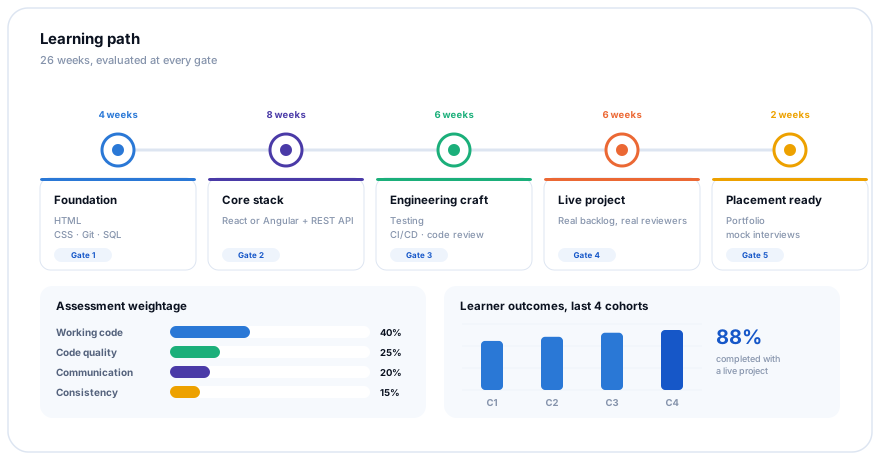
HTML, CSS, JavaScript fundamentals, Git, the command line and SQL. Ends with a small data-driven page built from a schema you designed yourself.
Gate 1: your work is in a repository with a clean commit history and a README someone else can follow.
One front-end framework in depth (React or Angular, your choice) plus a REST API in Node.js, .NET or Java, with authentication, validation and a real relational schema.
Gate 2: a working full-stack application with authentication, deployed somewhere a reviewer can open it.
Automated testing, code review, refactoring, debugging under pressure, CI/CD, logging and reading unfamiliar code — the skills that separate a developer from a graduate.
Gate 3: you fix a bug in a codebase you did not write, with a test that proves it, and review someone else's pull request usefully.
You join a real sprint team on a real backlog. Standups, estimates, code review, demos to a stakeholder. This is where most of the learning actually happens.
Gate 4: at least one feature of yours is merged and released, and you presented it in a demo.
Portfolio, résumé, a technical explanation of your own project, mock interviews with engineers who interview for real, and salary-conversation coaching.
Gate 5: you can explain every design decision in your project without notes.
Hours by activity type, per stage
Last four cohorts, at week 26
Take the full track, or a single course. Weekday, weekend and fully remote cohorts run in parallel; the assessment is identical in all three.
The complete track above: front end, API, database, testing, CI/CD and a live project.
Components, state, routing, forms, accessibility, performance and testing. One framework in depth rather than three superficially.
REST design, authentication and authorisation, validation, background jobs, caching, and SQL that does not fall over at scale.
Data preparation, classical models, evaluation done honestly, and how to deploy and monitor a model. Deliberately more evaluation than modelling.
SQL in depth, dimensional modelling, pipelines, orchestration, data quality testing and building a dashboard people trust.
Cross-platform UI, local storage, offline sync, push notifications and store release. Built around the offline-first problems real apps hit.
Test design, unit and API testing, end-to-end automation, CI integration, performance basics and accessibility testing.
Containers, infrastructure as code, CI/CD pipelines, monitoring and incident response on Azure or AWS.
Team upskilling on your own codebase, migration training (jQuery to Angular, monolith to services), code-review workshops, and faculty development programmes for colleges.
| Dimension | Weight | How it is judged |
|---|---|---|
| Working code | 40% | Does it run, handle bad input and meet the acceptance criteria? |
| Code quality | 25% | Readable, tested, reviewed and reasonably structured. |
| Communication | 20% | Can you explain a decision, ask a good question, review a peer? |
| Consistency | 15% | Steady weekly progress rather than a heroic final fortnight. |
Communication is 20% on purpose. In eleven years of hiring, the strongest predictor of whether someone becomes a good engineer is not their first commit — it is whether they can say what they do not understand.
Ours names the project you built, the stack you used and the gates you cleared, and carries a verification link. A certificate that only says "attended" is not worth printing.
Final-year, post-graduate and research students come to us for help building software they can defend. We mentor and review; we do not ghost-write. What you submit has to be yours.
Narrowing a question to something answerable in your timeline, with a defensible method.
Weekly sessions on structure, tooling and where your design will hurt later.
Repository, environment, seeded runs and a notebook your examiner can execute.
Honest baselines, correct metrics, clear figures, limitations stated.
A mock defence with hard questions, so the real one is not the first time.
Faculty development, lab setup, curriculum review and industry-project partnerships.
To be explicit: we will not write a dissertation, sit an assessment, or sell a finished project. If that is what you are looking for, we are not the right people — and any institution can tell the difference anyway.
No. We have taught mechanical engineers, commerce graduates, teachers and one civil engineer who is now a senior developer with a client. You do need basic programming for most courses, and genuine time — 30 hours a week for the flagship track is not negotiable.
All three formats run: weekday in person in Pune, weekends in person, and fully remote. Assessment, gates and reviewer access are identical. Remote learners join the same standups.
No, and we will not claim it. What we do: refer you into our client and partner network, prepare you properly for interviews, make you eligible for our own internship, and answer reference calls honestly. Anyone guaranteeing placement is either charging you for it or lying about the numbers.
You get specific written feedback and one re-attempt in the following two weeks, with extra pair sessions. If the second attempt does not clear, we talk honestly about whether the track is right for you — and refund pro-rata if we concluded together that admission was our misjudgement.
Yes, and many do. We invoice the organisation, provide progress reports if you agree to share them, and can run a private cohort on your own codebase for teams of six or more.
Clearing gate 3 makes you eligible to apply for the internship, and clearing gate 4 lets you skip its unpaid bootcamp stage and start directly on a live project with a stipend. See the internship page for the bands and the rubric.
Weekday, weekend and remote cohorts start every six to eight weeks. Tell us your background and available hours, and we will tell you honestly which course to start with — including if the answer is "learn the basics first, come back in two months".