
An internship on real software, paid on what you actually deliver
Twenty-four weeks on a live client application. The first four weeks are an unpaid, structured bootcamp. From week five you are in a sprint team and a stipend starts, sized by a performance band that is reassessed every fortnight. Sustain a strong band and you finish with an on-roll offer as an Associate Engineer. We publish the bands, the rubric and the outcomes below, because a performance-linked stipend is only fair if you can see the ruler.
Read this part first
Weeks one to four are unpaid. You are being trained intensively during them and not yet contributing to client delivery, and we would rather say that plainly than bury it. In return: no fee is charged at any stage, ever — not for training, not for certification, not for placement. If any part of an internship offer asks you to pay, that is not an internship.
From week five onward the internship is paid, and what you are paid depends on assessed performance rather than on hours present. Bands move in both directions. Everything that decides them is on this page.
From screening to on-roll
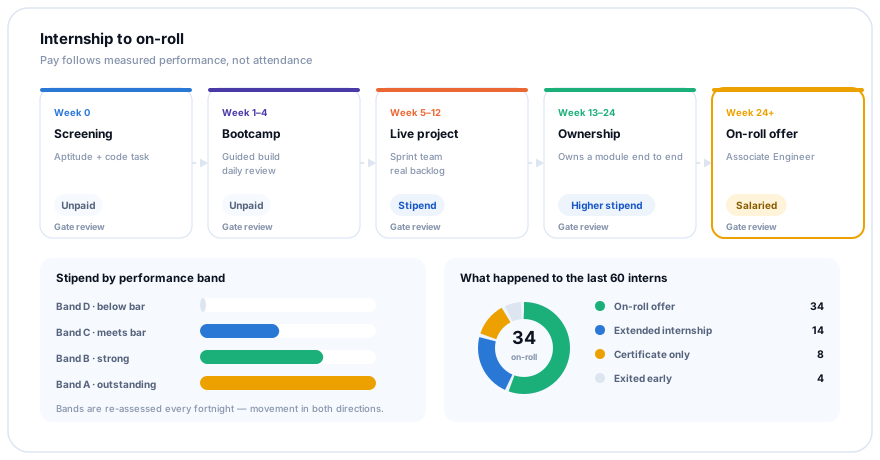
The 24 weeks, week by week
Hover any bar for what happens in that window
Paid or unpaid, and exactly why
Four bands. Your band is set at each fortnightly review against the rubric in the next section, and it can go up or down. Nothing is decided by a single person's impression.
| Band | What it means in practice | Weeks 5–12 | Weeks 13–24 | On-roll track |
|---|---|---|---|---|
| A · Outstanding | Ships independently, reviews others usefully, raises problems early, mentors newer interns. | Full stipend | Full stipend + ownership allowance | Offer expected |
| B · Strong | Completes assigned work to standard with normal review; occasional guidance needed. | ~70% of full | ~85% of full | Offer likely |
| C · Meets the bar | Delivers with regular support; quality acceptable after review iterations. | ~45% of full | ~60% of full | Extension offered |
| D · Below the bar | Work not yet usable without substantial rework; the gap is named specifically in writing. | Unpaid, with a two-week improvement plan | Programme usually concluded | Certificate for completed period |
What is never charged
- No training fee, at any stage
- No certification or documentation fee
- No placement or referral fee
- No security deposit or bond
What comes with every band
- A named mentor and weekly 1:1
- A real repository and real code review
- Written feedback every fortnight
- A certificate stating what you actually built
Also provided
- Laptop for on-site interns who need one
- All tooling, cloud and licence costs
- Travel support for on-site cohorts
- Remote participation where the project allows
The rubric your band is set against
Six dimensions, scored 1 to 4 every fortnight by your mentor and one reviewer who is not your mentor. You see the scores and the comments in full.
| Dimension | Weight | Band A looks like |
|---|---|---|
| Delivery | 30% | Committed work lands in the sprint, at agreed quality, without chasing. |
| Code quality | 20% | Readable, tested, follows the codebase conventions; review comments are mostly discussion, not corrections. |
| Autonomy | 15% | Unblocks yourself, then asks a specific question when genuinely stuck. |
| Communication | 15% | Clear standups, honest estimates, flags slippage early rather than on the deadline. |
| Collaboration | 10% | Reviews peers usefully, shares what you learn, leaves the codebase better for the next person. |
| Growth | 10% | Feedback from the last review is visibly acted on. |
A real intern's score trajectory
Weighted rubric score, by fortnightly review
Two rules that protect you. A band can only drop after you have had written feedback naming the specific gap and at least one fortnight to act on it. And no band decision is made by one person alone — your mentor and an independent reviewer must agree, or it escalates to the engineering lead.
Live application development, not a training sandbox
From week five you are on a client project with real users. That is the whole point — and it is why the bootcamp exists first.
Typical first tasks
- A well-scoped bug with a reproduction
- A new field through the full stack: form, API, database, test
- A report screen with filters and export
- Raising test coverage on a specific module
By week 13, ownership of
- A module: its backlog, quality and questions
- Its release notes and its documentation
- Answering support queries about it
- Its part of the sprint demo, presented by you
Guardrails on real work
- Nothing reaches production unreviewed
- You never carry a client escalation alone
- No production database access in the first 12 weeks
- A senior engineer is always on the same sprint
What happened to the last 60 interns
Outcome at week 24
Band distribution over the programme
Share of interns in each band, by stage
Who we take
- Final-year students, recent graduates, or career changers with demonstrable self-taught work.
- Any degree. We have taken mechanical, electronics, commerce and science graduates.
- You can write a small program in some language and explain how it works.
- You can commit 40 hours a week for 24 weeks (or 25 hours over 32 weeks if you are still in a final semester).
- You are comfortable with your code being reviewed publicly and directly.
What we do not require: a specific college, a minimum percentage, prior internships, or a certificate from us. Graduates of our academy who cleared gate 4 skip the bootcamp stage — but the programme is open to anyone who passes screening.
How screening works
-
Application
The form below. A link to any code you have written helps more than a résumé does.
-
Take-home task · 3–4 hours
A small, realistic problem. Use any language, any help you like, including AI tools — but you must be able to explain every line.
-
Conversation · 45 minutes
We walk through your task together, change a requirement, and see how you think. Not a quiz on algorithm trivia.
-
Written outcome within a week
Yes or no, with the reason. If it is no, we say what to work on and you may reapply after one cycle.
Internship questions
Why are the first four weeks unpaid?
Because in those four weeks a senior engineer's time is going into you, not into client delivery, and you are not yet producing work a client could use. We think paying from day one and then quietly recovering it through a lower overall stipend would be less honest. Nothing is charged to you either — the training itself is free.
Can I be moved down a band?
Yes, and it happens. But only after written feedback naming the specific gap and at least one fortnight to act on it, and only with two assessors agreeing. A drop is never a surprise at the review.
Is the on-roll offer guaranteed if I reach Band A?
An on-roll offer needs both a sustained Band A or B and an open role. In the last two years we have made an offer to every intern who finished in Band A. When headcount has been the constraint, we have said so directly and referred people into our client network with a strong recommendation rather than stringing them along.
What is the on-roll offer actually for?
Associate Engineer, on a full employment contract with the same review cycle, leave and benefits as any other engineer. You continue on the project you already know, which is why interns who convert tend to be productive immediately.
Can I do this alongside a final semester?
Yes, on the 32-week variant at 25 hours a week. Tell us your exam dates at application and we plan sprints around them. We will not ask you to choose between an exam and a release.
Is it remote?
The bootcamp is significantly better in person and we strongly recommend it. From week five, remote works well for most projects, though some client engagements require on-site presence — we tell you which before you accept.
Do you take more than one intern per project?
At most two per squad, so review capacity stays real. It is also why cohorts are small and applications sometimes wait for the next intake.